Sunday, June 10, 2012

Philly Pride!

So I've never been to a Pride parade. Or any kind of Pride event, really. I came out two years ago or so and since then I've been on a really long personal journey discovering how diverse the human population really is, and how much culture is associated with each group. It's really fascinating.

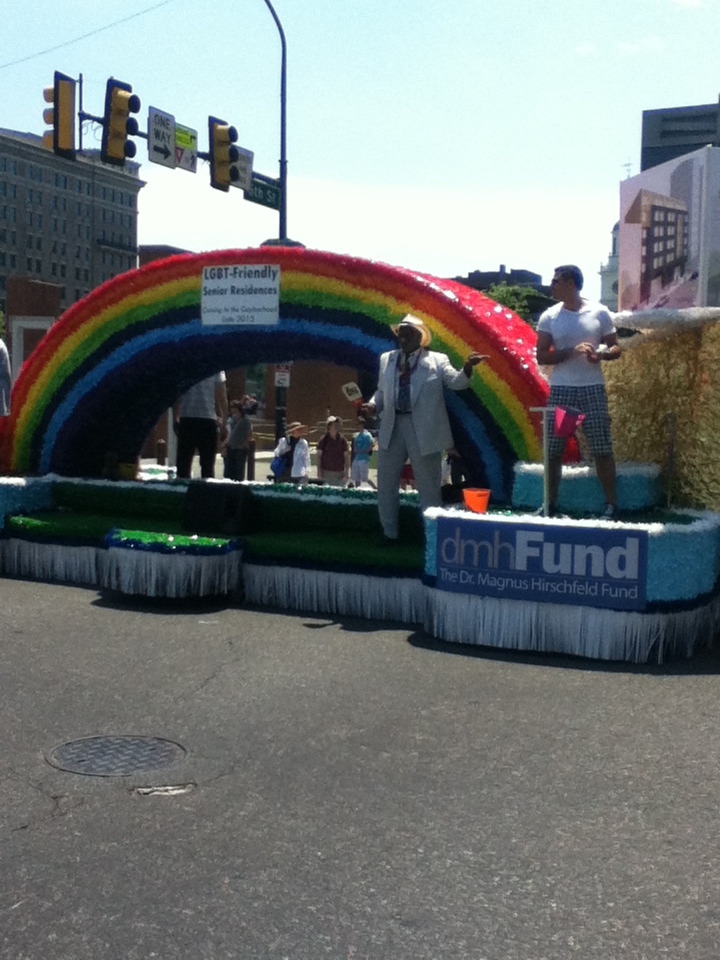
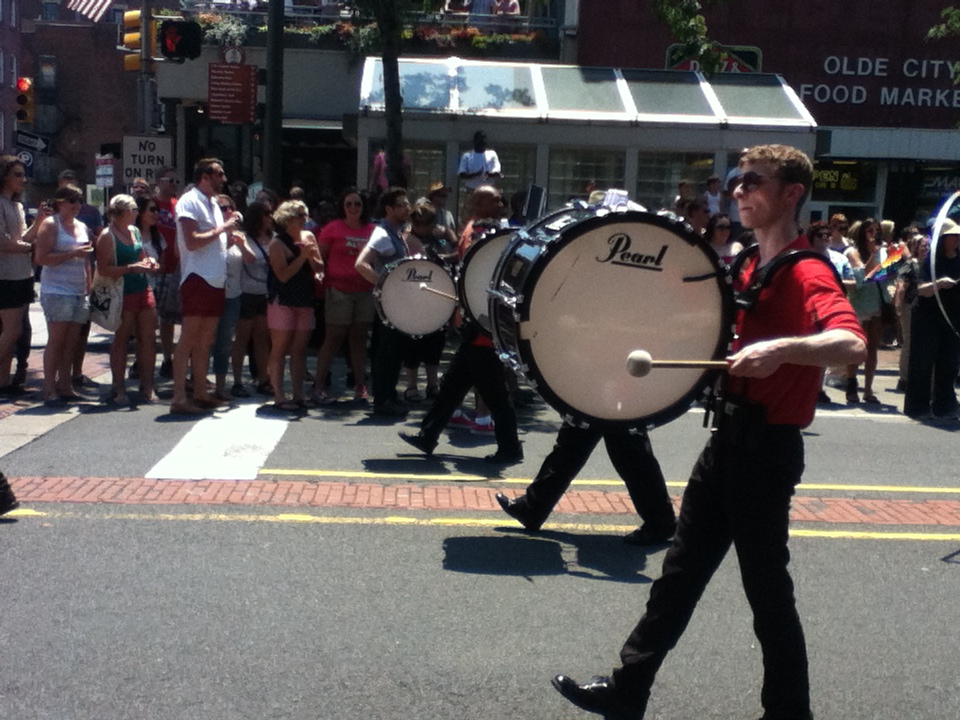
So this morning I woke up at like 11:30. Jose and I had planned on leaving to go to Pride around 11:00 because the parade started at noon, but we were able to make it and catch up with the parade before it got anywhere near the end. There were dads with their kids in their strollers everywhere, lots of people with signs, a lot of music, and a ton of drag queens. Oh, and of course the shirtless people walking around all over the place.


The Parade itself ended at about 2, but afterwards there was a party at the Penn Landing. Some of the people from the floats were there, but it was mostly the people who were standing on the street and hanging out. There were SO MANY PEOPLE. I put a couple photos below but they really don't do the place justice. There were a lot of sections of the park I just didn't take pictures of, but they were all full of people.


This is where all the performances went down. Some people sang, there were a  few drag shows, etc. It was really hard to see over people.


Cute. I wish I could do this in Missouri with my partner. :( Missouri sucks. 
 Well, Missouri doesn't exactly suck. In my opinion it's a matter of visibility. I guarantee nearly every person on earth knows at least one LGBT individual, though they may not know it. When we spend our lives in the closet it doesn't do anyone any good. So in the context of today's civil rights movement, I would say the most important thing we can do is come out and let people know we're here. We are friends, family, and neighbors to everyone from every walk of life. Those who are afraid of that type of diversity quickly get over their prejudices when they see we're like everyone else.

Except when we're on parade, of course. Then we're way more fabulous

The river there is gorgeous, so I snapped a pic of it as we were leaving. I was too tired after 4 hours of walking and being in the sun to do anything else, so we headed back up to where the buses ran and headed back to the dorms. We had some dinner with the rest of the IRCS group, and it was then that I realized (because of how many people commented on it) that I was red as a cherry. I'd applied one layer of sunblock after the parade, but it evidently wasn't enough to keep my skin from roasting like a papaya.
I'm not sure how well you can pick out the red all over my body in this picture, but suffice it to say I'm in a lot of pain. Lesson learned. Maybe.
After dinner I came back to my room to clean it up. Over the past 8 days it has become a mess of papers, articles, clothing, receipts, and poptart packages.

So after some cleaning I've managed to get everything trash-related into a big plastic bag that's just going to sit here for the next few days. On the group's Facebook page (our main method of group communication at this point) someone mentioned watching some documentary called Human Planet on the third floor lounge, so naturally I went down and watched a couple episodes with some people. It covers several environments where humans live in extreme conditions and how they overcome them. The most memorable part was the nomadic tribe living in the desert in Africa during the dry season. The people follow elephants around (because elephants are evidently very good at finding underground water), and then they draw the water out from the ground, leave some for the elephants, and then continue on their way. It's crazy!

Then sleep.

Saturday, June 9, 2012

A Day Off! But Not Really.

Since it's a Saturday we didn't have any talks to go to. The only scheduled event was a picnic-type lunch at the Farmer's market. Since my computer has not changed its time zone settings since I got here, I thought it was an hour earlier than it actually was, so I made it just in time to find everyone stretching and doing yoga stuff. I haven't stretched in years so for the next hour I kind of just flailed around and tried not to yell in pain when everyone else was reaching their noses to the tip of their feet. After half an hour of stretching we started doing handstands and cartwheels to see if we could get us all in a picture with our feet in the air, which took another half hour...


Afterward we decided to go to Center City and walk around to do some shopping. I was incredibly hungry and we were planning on going to an Indian restaurant that night for dinner, so I made a bad decision and ate a couple cheesebwergers at a local McD's. I got a courtesy water cup the size of a pea. 

I decided I needed a ukulele so that I could everyone sign it like the baritone I have back home. I looked online for the music shops around town and called a few until I found a store that had one on sale for $40. A nice one wasn't necessary since its only function would be to hold a bunch of signatures. The group convened at a cafe and went their separate ways to meet back up at 6:30 for dinner at the Indian place. I took the time to go downtown to get my ukulele.


On the way I ran into Old Town Philadelphia, where there were horse n' buggies, old brick buildings, historic statue, and just a totally different environment than what I've been used to seeing in Philadelphia. It's quieter, cuter, more full of local shops, and somewhat cleaner looking. It was about 3 miles from where I was to the music shop, so it took me a long time to get there. Eventually I was able to pick up my cheap uke and be on my way. 


On the 4 mile journey back to campus (yeah, I walked a LOT) there was a long line of flea market-like tiendas all situated along the sidewalk on South St. I didn't pick anything up, but I would definitely recommend going here to shop if you ever come into town, they had some really cool stuff. 


When I was crossing the Delaware back towards campus I had to stop for a couple minutes to take in the scenery. This city really is beautiful. 


With only 10 minutes to spare I made it back to the dorm where the group was meeting up. The whole 7 mile walk took a couple hours so I was exhausted and my feet hurt a lot by the time I got back. We headed northwest a couple blocks to the restaurant which was called "Kabobeesh." No idea what that means. Anyway, we had a girl from India in our group so we let her pick the food and just put in a few dollars each so we could sample several dishes. 

I see what you did there. 


I learned how they eat food in India: with one hand. Usually there's some kind of sauce you mix with the rice and it's easier to scoop up and eat out of your hand, but the stuff at the restaurant according to Debjani wasn't 100% authentic (but she said it was close) so it didn't work as well as I would have liked. Also, it was probably the spiciest meal I've ever had. By the end of the meal, my eyes were watering, my nose was dripping, and I was having problems breathing. 


After dinner, Jose (a friend from the IRCS group) and I decided to go out because we thought there was another block party that night. Apparently there wasn't, so we stuck around, had a couple drinks and met a whole lot of people that kept us talking until almost 3 in the morning. This city is crazy and full of nice people, it's amazing. We got back around 3:30 and I passed out almost instantly after falling into bed.

Friday, June 8, 2012

Accidentally in Love

So yesterday morning I actually woke up on time which made my whole day 100 times better. My shoe fell apart that morning:
So I figured it would be a good idea to go out and buy shoes after our lectures. First, we heard from Dr. Nicole Rust, who does research on the visuoperceptive system.

The neural mechanisms involved in finding specific objects and switching between targets
Nicole Rust

Dr. Rust hypothesized that in the brain, searching for an object and finding it had a very specific cognitive profile. She believed that there were specific neurons that fired for specific objects, and that working memory kept firing the same neurons to maintain the signal for an object for which one might look. The point of her research so far has been to figure out neural correlates instead of doing causal experiments (like with transmagnetic stimulation), but that will be the next step when she figures out the basics of this complicated process. There are three levels of cognitive processing she recognizes... except I can't remember the first one. The second is algorithm (how the brain picks out information) and the third is behavioral response. She is interested in figuring out the algorithms by which the brain picks out information. 

Her hypothesis is that there must be some form of 'bingo' neuron which fires when something you're looking for, no matter what the object is, as opposed to neurons that fire when you recognize an object you're not looking for. Well, she found some. They're in the inferior temporal lobe as well as the pherirhinal cortex. The required information is fed from the prefrontal cortex (working memory) for which object needs to be recognized, and this affects the visual information fed into the IT, which computationally formats the data into a linearly selectable matrix that the perirhinal cortex can read. Essentially, this means that a complicated process is used to separate distractor data vs. bingo match data in the IT, and the formats it in a way that is easily interpretable by another part of the brain. So yeah. This field is really young so we don't have the greatest understanding of it yet. 

Cracking the Code: Translating odorants into olfactory receptor responses
Joel Mainland 

This was cool but not really informative. Molecules all smell different according to features we don't understand. Enantiomers (molecules that look exactly the same but are mirror images of each other, like your left and right hand) smell different from each other, molecules which are very similar in structure with respect to functional groups are very similar, etc. There are two theories of how we smell things. First, we might use a lock and key system in which different molecules fit into different olfaction neurons which send information to the brain. The other is that there is some mechanism on those neurons that records their vibrations and uses that information to tell what molecule it is. It's possible that it's a mixture of both of these theories, or neither. However, there isn't really any evidence for the vibration theory, though it may be plausible. The lock and key model is used in many other biological processes already, so it is more likely that that is the case.

Fun fact. We have about 40 types of taste receptors on our tongues, 3 types of color receptors (RGY), and 400 different olfactory nerve endings. Crazy!

We got to smell about 800 vials of stuff to see just how different things smelled even if their molecular structure was very similar. 

___________________


After our lectures I needed shoes desperately. But I also only had one hour until I had to be back at IRCS for a graduate student panel thing. So, I started power walking into town, naturally. The music that came on my iPod first was "Accidentally in Love" by the Counting Crows, which about describes my feelings about Philadelphia. It was terrifying for the first few days, but I'm really beginning to like it here. The people are nice, the weather is awesome, there's a beach 40 minutes away, a downtown gayborhood, a prestigious university, and no Wal-Mart. Well... I think there's a Wal-Mart, it's just not readily accessible at the moment. Also, public transportation makes my life so much easier. 


I power walked across the river and into the city, about 20 blocks to the nearest Payless Shoe Source, ran in, bought a pair of shoes that were my size, and immediately ran out, changed shoes, and started jogging back to campus. I got in exactly on time but I was exhausted and covered in sweat so I imagine everyone thought I was pretty classy. There was a graduate student panel where we all got to ask graduate students from different fields everything we wanted to know about graduate school. Apparently, stats is way more important than I thought it was. Bleh. Also, I'm going to have to study a lot of programming and linear algebra, take time off in between undergrad and grad school, write a senior thesis, and drop whatever I'm doing during that time if I don't immediately like it.

Then there was food!

 Then there were posters! A lot of the students here have some some cool research and they got to share it with the rest of us. This is Tatiana. She's from Russia, and she's awesome. Also, her research essentially went over my head. There was one experiment another girl did that was pretty cool, in which she looked at the phoneme inventories of languages to see if the presence of certain vowels could predict with any accuracy the the presence of specific consonant sounds. No correlations yet, though. 

Next we went to Center City to see an interactive concert. The orchestra played Beethoven's 5th (1st and 3rd movements). After each movement, they had a few people come up one at a time to learn conducting and let them loose on the orchestra. One guy, after finishing, turned around to the audience and said, "Thank you all, this has been a dream come true. It's always been my dream to conduct an orchestra; when I was a kid, I would stand on top of a box with a pencil in hand and conduct to the music I played, so thank you all very much." He had a really strong English accent but he said he was from Poland. I saw someone's dream come true!

 After the concert, some of us headed farther down town to see the block party (it's an opening party for the Pride parade on Sunday). There were some games and a lot of dads were there with their kids playing foam sword fights and stuff. It was really cute and at least for me, unexpected. You always hear about gay dads but you never see them. Er... I don't, anyway. But I live in Missouri where you'd become a martyr instantly in that situation.

There were tons of people there. About twenty minutes after we arrived, the population of block partiers probably increased by a factor of 100. 

Then I went line dancing at a local bar. 

Then I met up with some friends to do more dancing!

Then we saw a drag show with pole dancers. 

Then we all found a bus and took it home and became the best of friends. The end.


Thursday, June 7, 2012

Chinatown!

Today was another loonnnnggggg day. Last night we went out to a club to dance and relax after all the straining mental work we've been doing. I got to wear a shirt I found in South Philly last night!

Only $20!

Needless to say we had a lot of fun, and I'm going to skip over the rest of the night because it's not that important.


Thalamic and cortical circuits for vision in the mammalian brain
Diego Contreras

Today was sensory perception day. We started out learning about the anatomy of neurons and we essentially beat the topic to the ground talking about action potentials, dendrites, axon girth, myelination, etc., etc... until we ran out of time and had to move onto the next lecture. The main points were that the thalamus is the relay point for almost all of our sensory perception tasks. Stimuli are first processed where they enter the brain, and then travel through the thalamus, which relocates the information to other areas, and then the information goes back through loops a couple times while it's processing new information. All our sensory perception is essentially put together and integrated through this looping process. The only sense which does not have a thalamic pathway is olfaction, since olfaction evolved long before the thalamus was present in mammalian brains. 

In future research, Dr. Contreras urged that we keep the thalamus in mind, since without it, there are no sensory processes (or at least, there's not a functional circuit). Also, myelin = bacon. 

Encoding of Natural Sounds in Auditory Cortex
Maria Geffen

Our second lecture dealt with auditory processing in mice but we didn't learn a whole lot. Sensory information can be integrated, compacted, and generalized in the human brain, meaning that instead of seeing a picture in pixels, we make generalizations like, "Oh, that's in the shape of a circle, and it's on a white background," instead of "This, this, and this pixel is white, and those three are black... etc... it must be in this shape," which is how computers interpret that information. 

We learned about resonant frequencies and how the brain interprets them. Auditory signals at various frequencies hit the celia in our ears and vibrate the timpanic membrane, which is translated into electrical signals that travel along neurons (each of which fires according to which frequencies are being produced) that are sent to the brain stem, shot through the thalamus, and finally processed in the primary auditory cortex. Whew. The neuronal responses vary according to whether the sound is natural, sped up, slowed down, or reversed. This response varies according to what species is hearing which sound. If mice hear mice sounds, there are peaks in neuronal activity, but there is no such activity of the sound comes from a marmoset, at least in specific neurons. Basically, there are about 30% of neurons in the primary auditory cortex that actually favor and are activated by 'natural sounds,' which do not exhibit the same excitatory properties when presented with other stimuli. In humans, there are many neurons that are specifically sensitive to human speech sounds. This is what allows us to focus on someone who's talking to us in a noisy room over music or other voices. It's pretty cool. 

Also, rats sing to each other at supersonic frequencies. It's kinda weird. 

____________

After our lectures today we did some really, really cool stuff. We went to another lecture sort of thing at the haptics lab near campus. The haptics lab does research on tactile functions of the brain and engineers devices to simulate the sense of touch in computers, robots, and various other mechanical tools. I didn't have a chance to take notes during the lecture but I did have a chance to take some pictures in the robotics lab, and some of their equipment, if not all of it, was pretty damn impressive. 

This robot cost $400,000+. It does high fives, fist pumps, and house chores. No joke. 

The little blue things are simulated fingers. They have little sensors underneath a rubbery membrane with fluid in between them. By measuring the pressure and conductivity at different points, the computer can measure what it's touching and the state of the sensors. These just came out last year and the technology is already really impressive, in my opinion. They're supposedly going to be used for robot hands, so they can 'feel' what they're touching and better measure how hard to hold something.

Now this is a cool machine. And the next picture. You sit on the chair and put your eyes into the viewing glasses, and put your hands on the control mechanisms. By moving your hands and fingers, you can control the instruments (pictured below) to perform various tasks. You can pick up objects, move them around, and push them with a lot of precision. It's been used for a few years to do surgery accurately and without making a large incision. Now, here's the coolest part: they have recently added a feature which actually allows you to feel what the instrument would be feeling. It has resistance if you move it where the instrument would not normally be able to move (like if you accidentally scratch the table, you friggin' feel it!), etc. It's one of the coolest things I've ever seen. 


Similar to the above apparatus, this machine measures the vibrations on an instrument, and replicates the exact same feeling in another, attached metal rod. The application for this is dentistry at the moment. By scratching on a tooth with a cavity (or on a normal tooth) and recording the vibrations as a sound file from within the instruments, the exact same feeling can be replicated anywhere with the machine and another of the special metal rods. In this way, students learning dentistry can feel exactly how it feels to find a cavity as opposed to a healthy tooth just by holding a rod. And it's almost mind blowing how accurately you feel the vibration. I scratched the table with the regular instrument and held the metal rod in my other hand, and felt the same thing. Whoah. 

The software on the computer is a 3-D modeling program which contains all sorts of information about whatever object has been programmed into it. Here, there's a layer of gel. The apparatus in the guy's hand is used to move the ball around on the screen in three dimensions, and it will generate resistance where there is resistance on the screen. So if you try to move the object on the screen with the ball, you will feel the gel bouncing back and generating resistance, even when it's bobbing up and down. There are several other objects, like a camera, a duck, etc., that were also available in the demo. It was crazy. 

In the same way the dentist tool vibrate-y thing works, this tablet and pen set mimics the vibrations of pre-recorded instruments on various surfaces. By using a measuring instrument to record vibration signals at various applied pressure on various surfaces at various speeds, and subsequently modeling those vibration paradigms in a computer, those signals can be generated in the tablet pen attached to a little metal coil/magnet. You can change what material you're sampling on the tablet, and then by writing on it, you can actually feel what it's like to write on that surface. There was also a little button that said "PUSH," which, when pushed, made it feel like you were breaking the glass on the tablet. But like, legitimately. SO COOL. 


After the robotics lab we went to dinner and then head down to Chinatown with one of the IRCS faculty members. We had some nice Chinese food, saw a rainbow, got some bubble tea, and went home. It was a great evening, and I'm keeping the end of this post short because I'm SO TIRED.


Someone mentioned my shirt matched the stairs and my shorts matched the walls, so I turned upside down for a photo op.